- Notícias
- Eventos
- Iniciativas Recorrentes
- Biografias e Trajetórias
- Cidades & Impérios: dinâmicas locais, fluxos globais
- Diversidade Cultural em Famílias Contemporâneas
- Encontros de Estudos sobre a China
- Encontros Experiências Migratórias
- Estudos Sociais sobre a Ciência e a Circulação do Conhecimento
- Fórum das Políticas Públicas
- Fórum Pesquisas CIES
- Género, Sexualidade e outros marcadores sociais de diferença
- Language, Power, and Social Boundaries
- Leituras ETNO.URB
- Movimentos Sociais e Ação Política
- Novas Perspectivas em História Moderna
- Revisitar o Século XIX
- Workshops de Investigação
- LIM | Workshops Metodológicos
- LIM | Métodos em Prática
- Encontros com a História
- Open calls
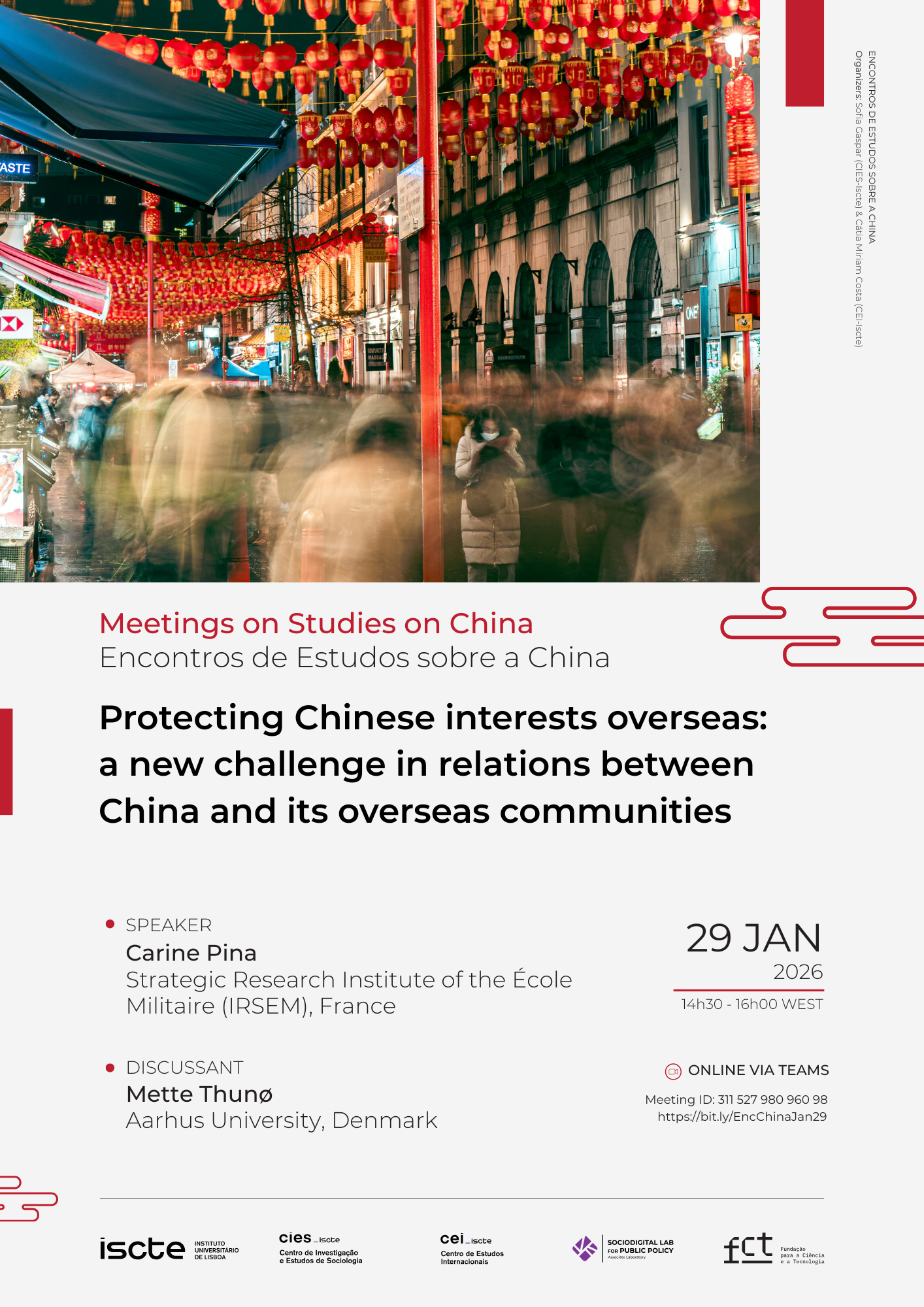
O próximo Encontro de Estudos sobre a China, regressa a 29 de janeiro de 2026, entre as 14h30 e as 16h00, em formato online.
O evento intitulado "Protecting Chinese interests overseas: a new challenge in relations between China and its overseas communities", conta com a participação da oradora convidada Carine Pina, Strategic Research Institute of the École Militaire (IRSEM), em Paris e com o comentário de Mette Thunø, Aarhus University, na Dinamarca.
LINK TEAMS
Meeting ID: 311 527 980 960 98
https://bit.ly/EncChinaJan29
RESUMO
China undoubtedly represents a unique case in the history of relations between countries of origin and countries of emigration. From the mid-19th century onwards, the leaders of the Empire established a policy to maintain special ties with Chinese emigrants, a policy that was often continued by their successors. Following the policy of openness and modernisation initiated by Deng Xiaoping in 1978, the project to involve overseas Chinese in China's economic and social modernisation once again resurfaced. This revival ushered in a new policy of connection, accompanied by new departures and the formation of new overseas communities — signs of a China that was becoming increasingly integrated into the global economy. Since the 1980s, the Chinese authorities have maintained a traditional, essentially utilitarian view of emigrant communities: overseas Chinese and their descendants are presented as supporters of China's economic and political future, both nationally and internationally. To this end, China is developing and implementing specific policies at central and local levels, including migration policies to manage flows, diaspora policies to maintain ties and achieve utilitarian aims, and, more recently, policies to provide extraterritorial protection. Although extraterritorial protection of Chinese communities is not new in Chinese foreign policy, it has only really taken shape in the last two decades. This protection addresses needs and mobilises resources that must be organised, enabling the Chinese authorities to pursue their interests with regard to both overseas Chinese communities and other states.
BIOGRAFIAS
Carine Pina is a researcher specialising in China and the Chinese world at the Strategic Research Institute of the École Militaire (IRSEM), Paris. She holds a PhD in law and development economics and is a sinologist. Her work focuses on China's expansion and international relations in relation to Chinese international migration.
Mette Thunø is Associate Professor at Aarhus University, Denmark, where she lectures on contemporary China within the Department of Global Studies’ China Studies Section. Between 2006 and 2010, she served as Vice Dean of Research at the University of Copenhagen, and from 2010 to 2014, she was the Dean of the Faculty of Arts at Aarhus University. She co-founded the “China-Europe Research Platform on Chinese Migration to and beyond Europe” (CERPE) with Professor Li Minghuan, Xiamen University. Her research primarily focuses on global China, specifically exploring China-Europe relations concerning migration and diplomacy, along with China’s recent diaspora policies. She has authored numerous works on Chinese migration and transnationalism, including co-authoring Transnational Chinese: Fujianese Migrants in Europe (Stanford UP, 2004), editing Beyond Chinatown (NIAS, 2007), and she is the Editor-in-Chief of the Handbook of Chinese Migration to Europe (Leiden: Brill, 2024). Her latest research projects involve using computational methods to study Chinese diplomacy on Twitter and ethnic Chinese media in Europe.