- Notícias
- Eventos
- Iniciativas Recorrentes
- Biografias e Trajetórias
- Cidades & Impérios: dinâmicas locais, fluxos globais
- Diversidade Cultural em Famílias Contemporâneas
- Encontros de Estudos sobre a China
- Encontros Experiências Migratórias
- Estudos Sociais sobre a Ciência e a Circulação do Conhecimento
- Fórum das Políticas Públicas
- Fórum Pesquisas CIES
- Género, Sexualidade e outros marcadores sociais de diferença
- Language, Power, and Social Boundaries
- Leituras ETNO.URB
- Movimentos Sociais e Ação Política
- Novas Perspectivas em História Moderna
- Revisitar o Século XIX
- Workshops de Investigação
- LIM | Workshops Metodológicos
- LIM | Métodos em Prática
- Encontros com a História
- Open calls
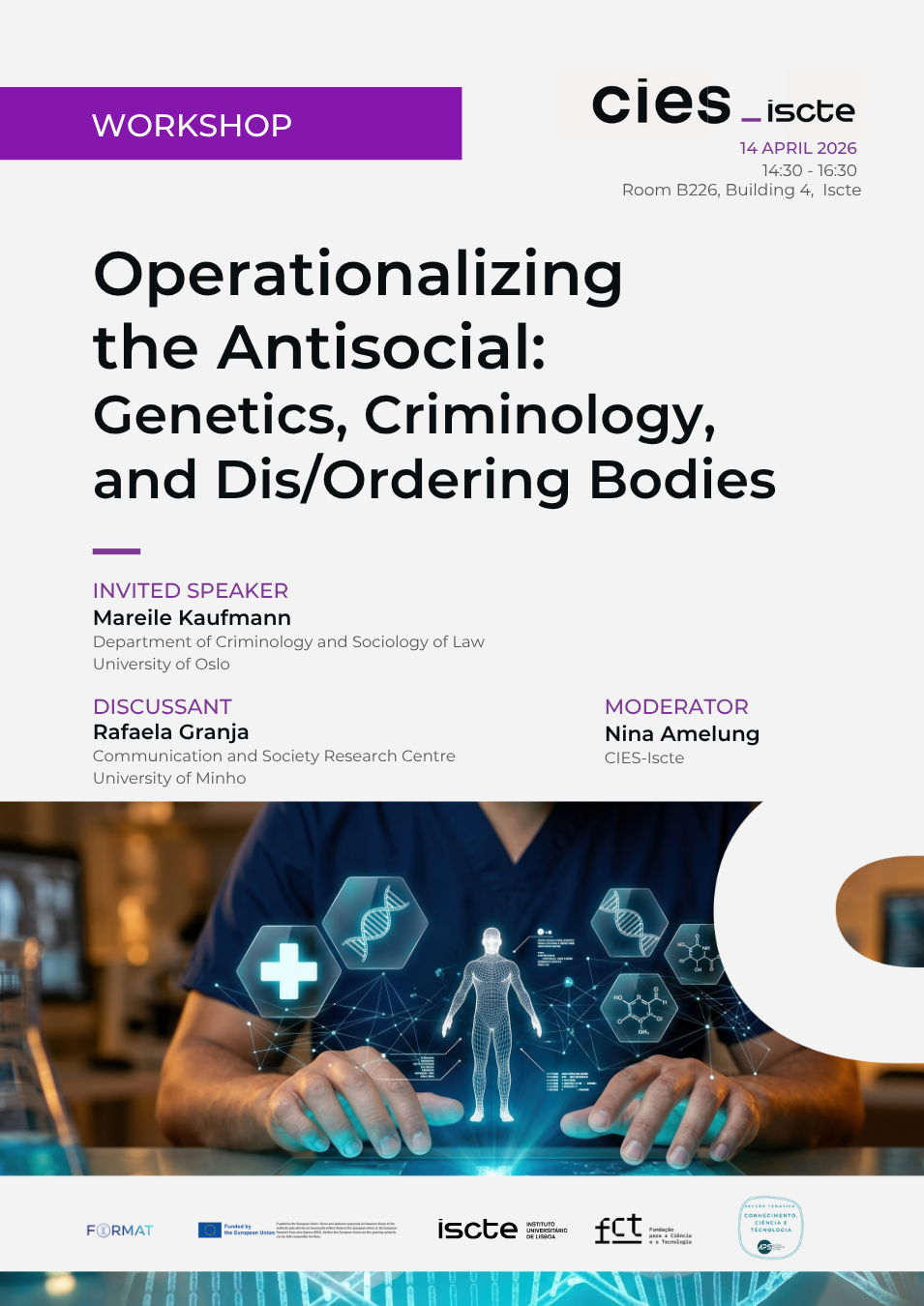
The next CIES research workshop will take place on April 14, 2026, in Room B226, Building 4, at Iscte – University Institute of Lisbon.
INVITED SPEAKER
Mareile Kaufmann
Department of Criminology and Sociology of Law
University of Oslo
DISCUSSANT
Rafaela Granja
Communication and Society research Centre
University of Minho
MODERATOR
Nina Amelung
CIES-Iscte
LINK ZOOM
https://bit.ly/WSCIES_abr2026

ABSTRACT
The arrival of big genome data stimulated a fascination with genomic predictions. DNA phenotyping - the prediction of observable traits from the genome, Genome Wide Association Studies and Polygenic (Risk) Scores define research agendas in biology and medicine, but also foster links to psychology and sociology. The emerging field of behavioural genetics and its uptake in criminology, I argue, is one such link that adds new qualities to sociological analyses of Nikolas Rose’s ‘somatic society’ or Ian Hacking’s ‘human kinds’. In extension of these and critical studies on phenotyping I offer an analysis of what I term ‘dis/ordering bodies’.
Biosocial Criminology has long argued that there is a bodily substance to crime - an argument that has been shaped by the discipline’s relationship to pathology. Big genome data offers means to think that relationship anew. Situated at the intersection of psychology, medicine and criminology the ‘antisocial phenotype’ emerges as an analytic focus. It connects genetic analyses of mental disorders to issues of crime and disorderly behaviour. Based on a systematic literature study of over 700 research papers and expert interviews I trace how this relationship is crafted scientifically and technologically, where the relationship between order and disorder is articulated in several ways. The aesthetic rationalism of big genome data methods is one such articulation of order: computation establishes analytic distance from the messy bodies and their messy behaviour. At the same time, it also assumes the scientific authority to re-inscribe orderliness and disorderliness into bodies at the molecular level.
BIOGRAPHIES
Mareile Kaufmann is a professor at the Department of Criminology and Sociology of Law, University of Oslo. Her current work consolidates and further shapes the field of digital criminology with a specific focus on data practices. She works with qualitative research designs that combine theory with innovative angles and strong empirical components. This combination also shows itself in the range of groups she interviewed and co-produced research with, including intelligence officers, state officials, forensic scientists, software developers and algorithm designers, as well as social media users who were exposed to terror attacks, hackers, artists and children. She is the author of the critically acclaimed monograph Making Information Matter and co-editor of the first handbook on digital criminology. Mareile is currently the PI for an ERC StG project on the changing relationships between digital technologies and DNA.
Rafaela Granja holds a PhD in Sociology from the Institute of Social Sciences at the University of Minho (2015) and is a researcher at the Communication and Society Research Centre (CECS) at the same university. Her research interests lie at the intersection of the sociology of crime and justice and the social studies of science and technology, focusing on the technological surveillance of criminalized populations at various stages of the criminal justice system, namely: criminal investigation, electronic monitoring, and imprisonment. She was recently the coordinator of the project E-MONITORING: Electronic monitoring in the criminal justice system: Projected futures and lived experiences (ref. 2023.00030.RESTART), funded by the Foundation for Science and Technology (FCT), and is currently the coordinator of the UMinho team participating in the European research consortium ForMAT: Forensic Methylation Analysis Toolsets, funded by the European Commission under the Horizon Europe programme.
Nina Amelung, sociologist, is integrated research fellow at CIES-Iscte. Her research interests lie at the intersection of critical migration and border studies and science and technology studies. In her research she focuses on datafied migration and border control regimes, data activism, migrants' rights movements and resistance. Previously, she worked on how transnational biometric data exchange, such as forensic DNA data, reconfigures our understanding of borders. She co-authored the book “Modes of Bio-Bordering: The Hidden (Dis)integration of Europe” (Palgrave).