- Notícias
- Eventos
- Iniciativas Recorrentes
- Biografias e Trajetórias
- Cidades & Impérios: dinâmicas locais, fluxos globais
- Diversidade Cultural em Famílias Contemporâneas
- Encontros de Estudos sobre a China
- Encontros Experiências Migratórias
- Estudos Sociais sobre a Ciência e a Circulação do Conhecimento
- Fórum das Políticas Públicas
- Fórum Pesquisas CIES
- Género, Sexualidade e outros marcadores sociais de diferença
- Language, Power, and Social Boundaries
- Leituras ETNO.URB
- Movimentos Sociais e Ação Política
- Novas Perspectivas em História Moderna
- Revisitar o Século XIX
- Workshops de Investigação
- LIM | Workshops Metodológicos
- LIM | Métodos em Prática
- Encontros com a História
- Open calls
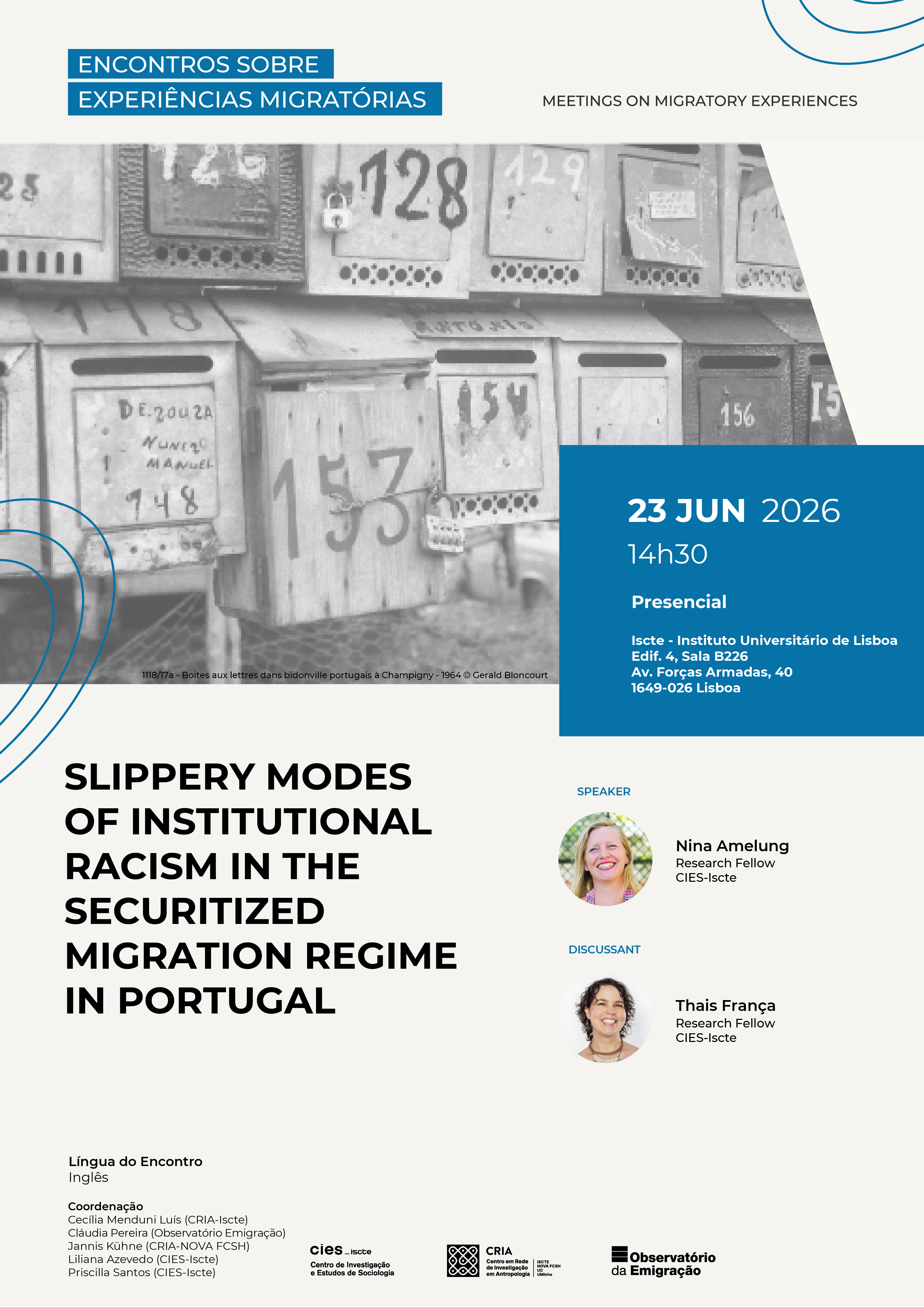
O Encontro de Experiências Migratórias de junho de 2026, realiza-se em formato presencial no Iscte – Instituto Universitário de Lisboa.
Esta edição aborda manifestações e práticas contemporâneas de racismo institucional no contexto de um regime de gestão da migração cada vez mais securitizado em Portugal.
LOCAL
Sala B226, piso 2, Ed.4 Iscte
ORADORA
Nina Amelung
Research Fellow, CIES-Iscte
COMENTÁRIO
Thais França
Research Fellow, CIES-Iscte
ABSTRACT
In her presentation, Nina Amelung will discuss a paper she co-authored with Susana Fereira. The authors engage with contemporary manifestations and practices of institutional racism as part of an increasingly securitized migration management regime in Portugal. They focus on differential legal, bureaucratic, and data management treatments to which some non-citizens are exposed when they want to claim their rights. The authors aim to attend to the slippery modes of doing differences in society that criminalize and marginalize migrant populations and have multiple racializing effects, thus to the slippery politics of race. The paper relies on an analysis of interviews conducted with civil society actors, legal and policy documents and media coverage of the migration management and public discourse on migration in Portugal. First, the EU wide turn towards stricter anti-migration and surveillance policies manifested in the New Pact on Migration and Asylum constraints Portugal. Together with national dysfunctional structures of migration bureaucracy this creates a drastic precarious panorama for racialized and marginalized migrants to access their rights. Second, differential legal treatments to define protection, residential status and access to rights across different national population groups adds to the experience of racism of migrants. Third, the criminalization of migration in public discourse driven by the Far Right creates a legitimizing ecology for institutional racism.
BIOS
Nina Amelung is Integrated Researcher at the Center for Research and Studies in Sociology at Iscte - University Institute of Lisbon (CIES-Iscte), and associated researcher at the Institute of Social Sciences, Universidade de Lisboa (ICS-ULisboa). Her research interests include political sociology, science, knowledge and technology studies, and critical migration and border studies. She explores the relationships between emerging publics, social movements, issues of citizenship and democracy, and digital and biometric technologies applied in migration and crime control regimes.
Nina Amelung is also co-coordinator of the Thematic Section on Knowledge, Science and Technology of the Portuguese Sociological Association (APS), the independent research network STS-MIGTEC and the leadership team of the Cost Action DATAMIG (Data Matters: Sociotechnical Challenges of European Migration and Border Control).
She published the books "Modes of Bio-Bordering: The Hidden (Dis)integration of Europe" (Palgrave) and "Material Politics of Citizenship: Connecting Migration with Science and Technology Studies" (Routledge) and various articles in journals such as Science as Culture, Public Understanding of Science, Social Studies of Science, Journal of Ethnic and Migration Studies, Citizenship Studies, New Genetics and Society, British Journal of Criminology, Security Dialogue.
Thais França is a Researcher Fellow at the Center for Research and Studies in Sociology at Iscte - University Institute of Lisbon (CIES-Iscte). She is a feminist researcher working at the intersection of gender, migration and decolonial studies. Her research focuses on the everyday experiences of racialised and gendered individuals, using qualitative and intersectional approaches that value the voices and lived experiences of participants.