A policy brief developed by researchers at OPAC – Observatório Português das Atividades Culturais, under the Science4Policy programme, puts forward an unprecedented proposal for the monitoring and evaluation of public funding for the arts in Portugal. The document stems from the project "IMPACTPP – Innovation in the Evaluation of Public Policies for Art and Culture", focused on developing analytical tools to strengthen evaluation in this field.
The study examines the Sustained Support Programme in its four-year modality, managed by the Directorate-General for the Arts, one of the country's main cultural policy instruments. Despite its relevance and the scale of resources involved, a structured system of indicators capable of systematically tracking its results and impacts had never been established. Building on this diagnosis, the researchers developed a conceptual framework based on the Theory of Change, which links resources, activities, outputs and impacts, underpinning the proposal for an integrated evaluation system. The main outcome is the definition of a framework of 43 indicators, distributed across monitoring and evaluation, covering dimensions such as effectiveness, efficiency, equity, sustainability, diversity of cultural offer and audience participation.
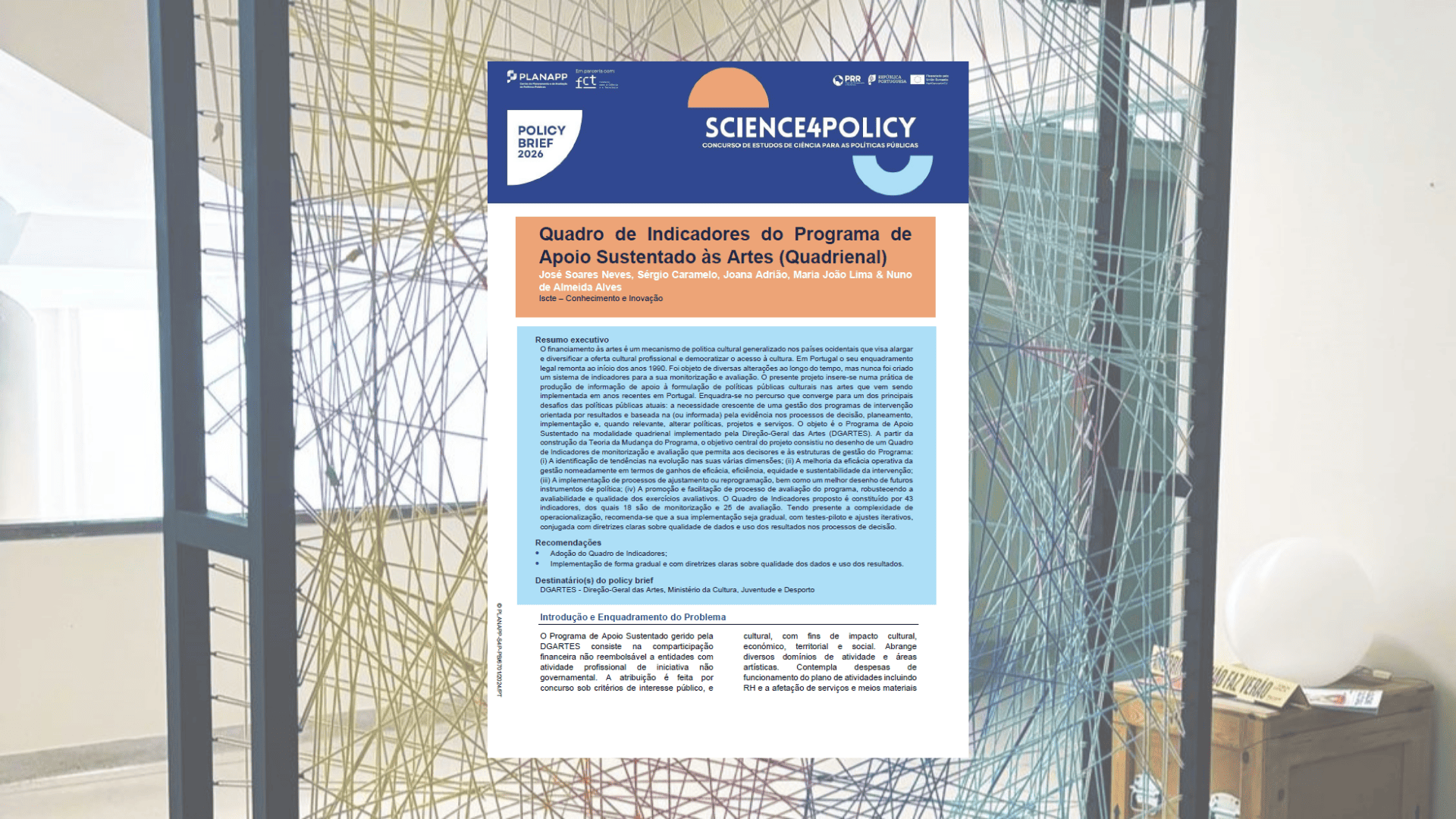

According to the authors, this instrument can support public decision-makers in identifying trends, improving programme management and shaping future cultural policies, while contributing to greater transparency and the use of evidence in decision-making processes. Implementation is expected to be gradual, with pilot testing and particular attention to data quality.
Developed within the Science4Policy initiative, promoted by PLANAPP in partnership with the Foundation for Science and Technology, the policy brief illustrates the contribution of scientific research to the design and improvement of public policies in the cultural sector.