- News
- Events
- Recurring Events
- Biographies and Trajectories
- Cidades & Impérios: dinâmicas locais, fluxos globais
- Cultural Diversity in Contemporary Families
- Meetings on China Studies
- Meetings Migration Experiences
- Social studies on science and the circulation of knowledge
- Public Policy Forum
- Research Forum CIES
- Gender, Sexuality and other social markers of difference
- Language, Power, and Social Boundaries
- ETNO.URB Readings
- Social Movements and Political Action
- New Perspectives on Modern History
- Revisiting the 19th Century
- Research Workshops
- Methodological Innovation Workshops
- Calls
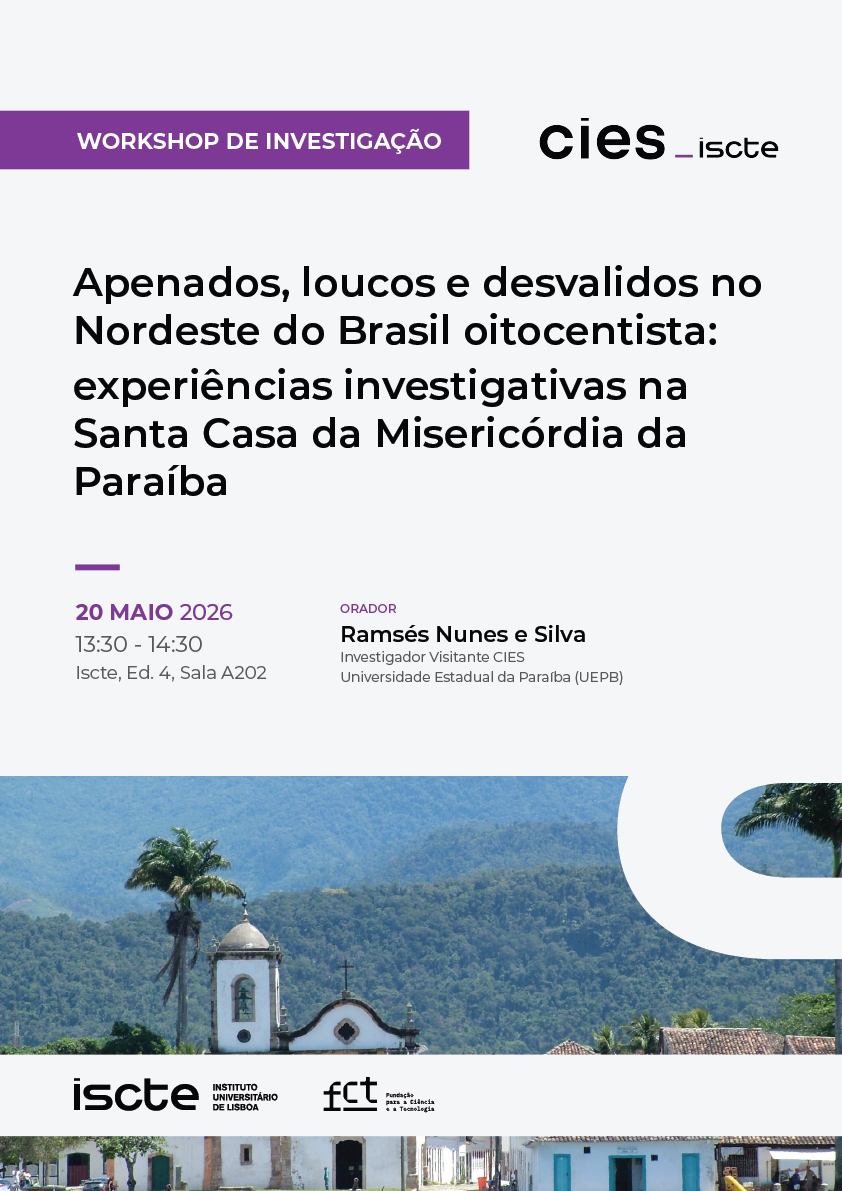
The next CIES Research Workshop will take place on 20 May 2026, under the theme: “Prisoners, the Insane and the Destitute in Nineteenth-Century Northeast Brazil: Research Experiences at the Santa Casa da Misericórdia da Paraíba”
VENUE
Room A202, Building 4, Iscte
SPEAKER
Ramsés Nunes e Silva
Visiting Researcher at CIES
Universidade Estadual da Paraíba (UEPB)
ABSTRACT
This postdoctoral research project proposes a comparative and evidentiary analysis of experiences of criminality, madness, and welfare within the Luso-Brazilian context, focusing on the activities of the Misericórdias of Paraíba and Coimbra between the second half of the nineteenth century and the early twentieth century. The research is grounded in shifting paradigms regarding custody and the sharing of archival holdings, engaging with the historiography of Peter Burke, Carlo Ginzburg and François Dosse, as well as archival theory developed by José Maria Jardim and Heloísa Liberalli Bellotto. The study is situated within the transition to juridical modernity and the secularisation of the Iberian world, in which notions of Christian beneficence and state bureaucratic-assistential mechanisms become hybridised within a “society of control,” as conceptualised by Gilles Deleuze and Erving Goffman. The central objective is to map documentary records of Lusitanian origin concerning “criminality” in Parahyba do Norte, examining how welfare and legal models circulated across both sides of the Atlantic.
The methodology is structured in two complementary stages. The first focuses on the documentary corpus of the Misericórdia of Paraíba, comprising administrative reports, psychiatric case files, and orphan records. In this phase, the research adopts a Digital History and Data Curation approach, conducted within the UEPB laboratory. The technical processing goes beyond traditional cataloguing, involving metadata structuring and the digital preservation of nineteenth-century manuscripts, with the aim of ensuring interoperability and sustained access to these complex archival holdings. The second stage will take place in Portugal and will involve the survey of the archive of the Misericórdia of Coimbra, with particular emphasis on social welfare records and orphanage-related fonds. Through a comparative perspective, the study seeks to examine how Portuguese documentary and normative frameworks were appropriated and hybridised in Brazil.
The project is expected to contribute to the development of an evidentiary framework for the classification of primary sources that reflect the discursive circulation between Iberian welfare practices and the modernisation of institutions of control. By confronting the realities of Coimbra and Paraíba, the research highlights the circulation of panoptic models and the legal implications that shaped representations of marginality in Luso-Brazilian culture, employing digital curation as both a tool for preservation and a method of historical analysis.