- News
- Events
- Recurring Events
- Biographies and Trajectories
- Cidades & Impérios: dinâmicas locais, fluxos globais
- Cultural Diversity in Contemporary Families
- Meetings on China Studies
- Meetings Migration Experiences
- Social studies on science and the circulation of knowledge
- Public Policy Forum
- Research Forum CIES
- Gender, Sexuality and other social markers of difference
- Language, Power, and Social Boundaries
- ETNO.URB Readings
- Social Movements and Political Action
- New Perspectives on Modern History
- Revisiting the 19th Century
- Research Workshops
- Methodological Innovation Workshops
- Calls
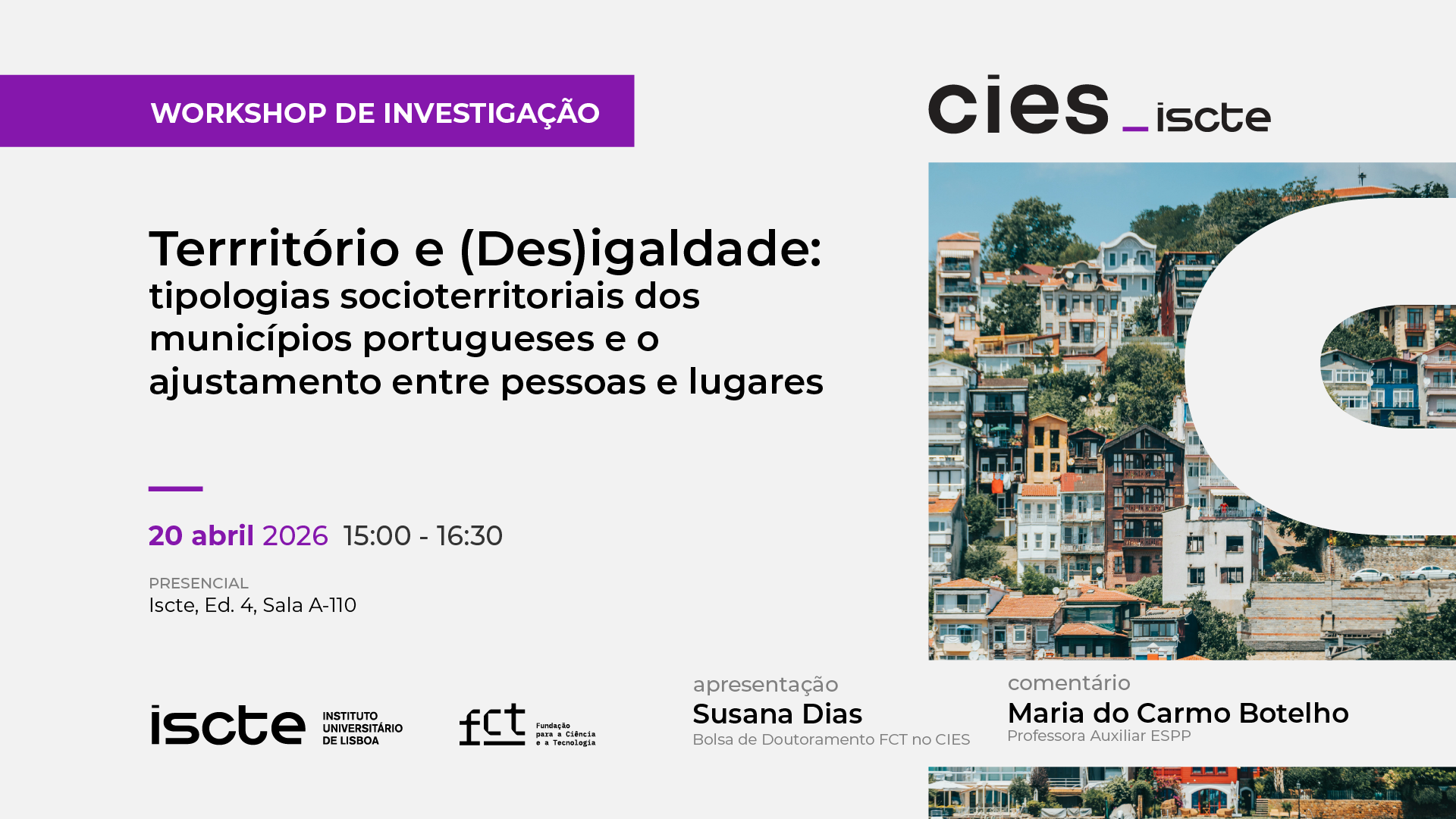
The CIES Research Workshop "Território e (Des)igualdade: tipologias socioterritoriais dos municípios portugueses e o ajustamento entre pessoas e lugares" will take place on 20 April 2026, from 3:00 PM to 4:30 PM.
VENUE
Room A-110, Building 4, Iscte
SPEAKER
Susana Dias
FCT Doctoral Research Fellow at CIES
DISCUSSANT
Maria do Carmo Botelho
Assistant Professor, ESPP
ABSTRACT
This project is grounded in an understanding of territories as dynamic social constructions, shaped by the interplay of resources, opportunity systems and social practices. Against a backdrop of pronounced socioterritorial asymmetries in Portugal, the study aims to examine how the configurations of Networked Urban Territories (TUR; Mauritti et al., 2022) condition population renewal, with a focus on families with children and young people, and in light of person-place adjustment processes. Methodologically, a mixed-methods approach is adopted. The quantitative component involves the characterisation of Networked Urban Territories and the analysis of the sociodemographic profiles of families with children and young people across these territories, drawing, in each of the studies, on multivariate analysis techniques. The qualitative component is based on semi-structured interviews with families with children and young people residing in TUR, seeking to capture residential choice rationales, perceptions of quality of life, and the adjustment between resources and opportunity systems across distinct territorial contexts. The study expects to identify differentiated territorial configurations and patterns of (mis)alignment between resources, opportunity systems and family expectations, highlighting critical factors for population renewal.