- News
- Events
- Recurring Events
- Biographies and Trajectories
- Cidades & Impérios: dinâmicas locais, fluxos globais
- Cultural Diversity in Contemporary Families
- Meetings on China Studies
- Meetings Migration Experiences
- Social studies on science and the circulation of knowledge
- Public Policy Forum
- Research Forum CIES
- Gender, Sexuality and other social markers of difference
- Language, Power, and Social Boundaries
- ETNO.URB Readings
- Social Movements and Political Action
- New Perspectives on Modern History
- Revisiting the 19th Century
- Research Workshops
- Methodological Innovation Workshops
- Calls
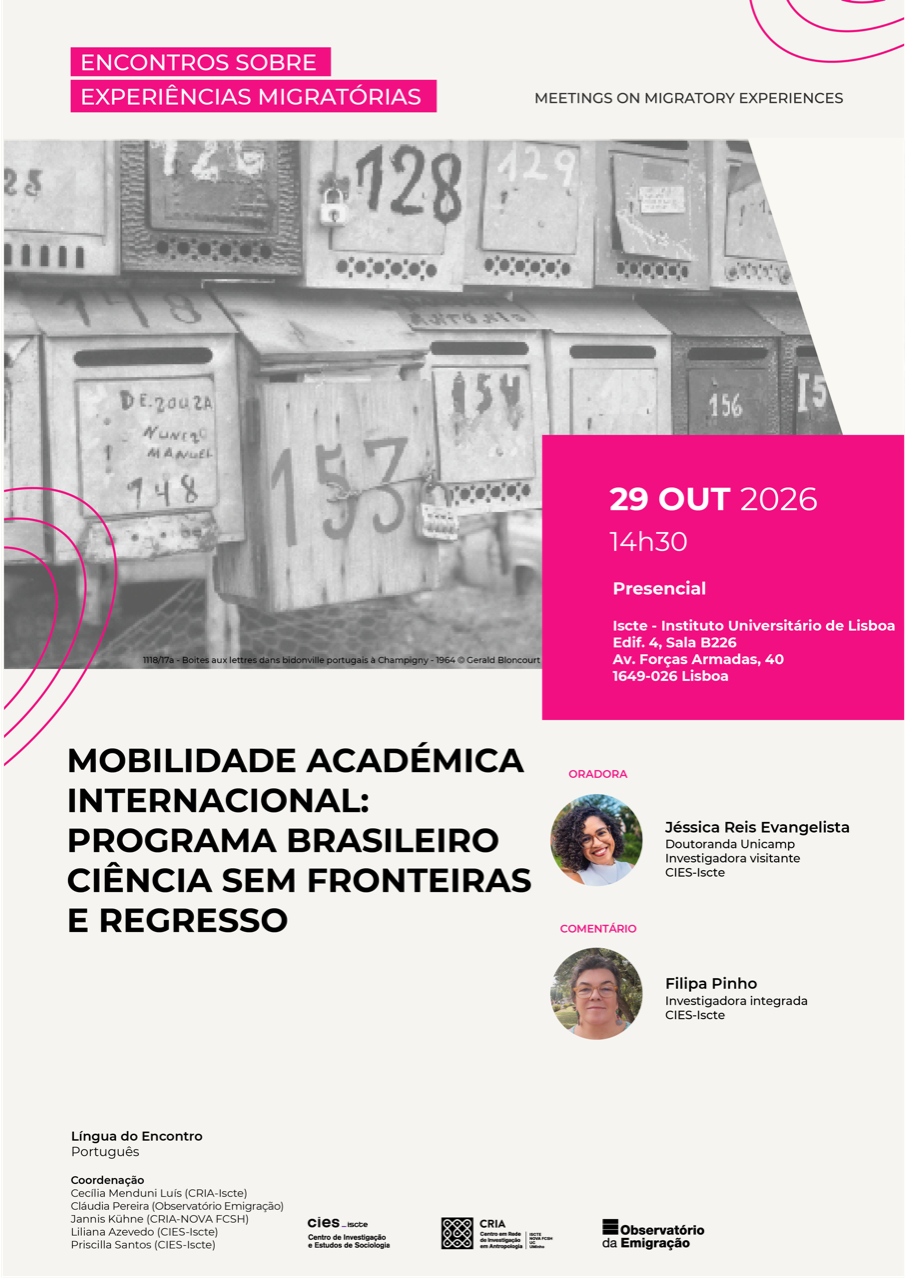
DATE 29 October
TIME 2:30 pm
VENUE Iscte, Building 4, Room B226
SPEAKER Jéssica Reis Evangelista, PhD candidate at Unicamp (Brazil) and Visiting Researcher at CIES-Iscte
DISCUSSANT Filipa Pinho, Integrated Researcher at CIES-Iscte
ABSTRACT
This research investigates the long-term effects of international student mobility on the personal, academic and professional trajectories of former participants in the undergraduate study-abroad component of the Science Without Borders Programme (CsF). Between 2011 and 2016, the programme awarded 78,900 scholarships to undergraduates in strategic science and technology fields, with the aim of promoting national development. Although CsF represents Brazil’s largest internationalisation policy, monitoring and evaluation of its former participants’ trajectories remain limited.
To address this gap, a qualitative study was developed using a combination of data generation strategies: an online questionnaire that yielded 861 valid responses, and 78 narrative interviews informed by Fritz Schütze’s theoretical and methodological approach.
Preliminary findings reveal that former participants are predominantly cisgender, with 51.92% identifying as men and 46.57% as women, white (67.48%), non-disabled (95.70%), and from privileged family and educational backgrounds. These findings align with other studies highlighting inequalities in access to the programme.
In terms of the effects of mobility, CsF marked a turning point in participants’ trajectories, with implications for identity, language, culture and professional life, broadening their horizons and opportunities in Brazil and abroad. The findings show that 76% hold postgraduate qualifications, 66% work in their field of study, 71.78% earn upper-middle or high salaries, and 23.23% live abroad.
Despite these positive effects, two aspects must be considered: i) the context of mobility, including the destination country, language, duration of the exchange, and factors relating to gender, colour/race, class, disability and geographical origin; and ii) the return to the country of origin, shaped by feelings of not belonging, difficulties with the recognition of academic credits, mental health issues, and the lack of institutional spaces offering support and opportunities to share international experiences.